
Why does a profitable company like Nvidia still borrow billions?
Nvidia makes huge profits yet sold $25bn in bonds drawing $85bn in orders. Why issuing debt while cash-rich is strategy, and what bond demand really signals.
By the Deriv desk · 24 June 2026 · 4 min read

A profitable firm borrowing money is usually a choice about the cost of capital, not a sign it is short of cash. Nvidia generates enormous profit, yet it sold $25 billion in bonds. That is not weakness. Debt is a tool, and the cheapest capital wins.

Why borrow when you are swimming in cash?
Cash is not free. It sits earmarked, it gets taxed when it moves, and spending it on long-term projects drains your buffer. Debt solves all three.
Interest payments are tax-deductible in most cases. Equity dividends are not. So borrowing can be cheaper than spending your own money once tax is in the picture.
The bigger prize is optionality. Borrow at a fixed rate today and your cash stays free for whatever comes next: an acquisition, a downturn, a sudden chance to move fast. A company that keeps its powder dry has more moves available than one that just spent it all.
The Apple playbook, repeated
This is an old lesson. From 2013, Apple sat on a mountain of cash and still issued tens of billions in bonds to fund buybacks and dividends. Repatriating overseas cash would have triggered tax, so borrowing was simply cheaper.
Apple's credit stayed pristine and the strategy got copied across the blue-chip world. In 2020 and 2021, firms rushed to lock in record-low coupons. The ones who borrowed before the 2022 rate-hiking cycle gained a cost advantage that lasted years.
The pattern holds: borrow cheap while you can, keep the cash flexible.
An oversubscribed bond sale is a confidence vote
Here is the part traders miss. Nvidia's $25 billion sale drew more than $85 billion in orders. Lenders wanted to hand it more than three times the money on offer.
When institutions fight to lend a company money at tight spreads, that is a vote of confidence you can read. They are betting they will be paid back comfortably. The order book is a live measure of how the smart money rates the borrower's future cash flows.
Nvidia is not alone. JPMorgan says AI and data-centre debt issuance has topped $300 billion this year. The whole sector is choosing debt to fund the build.
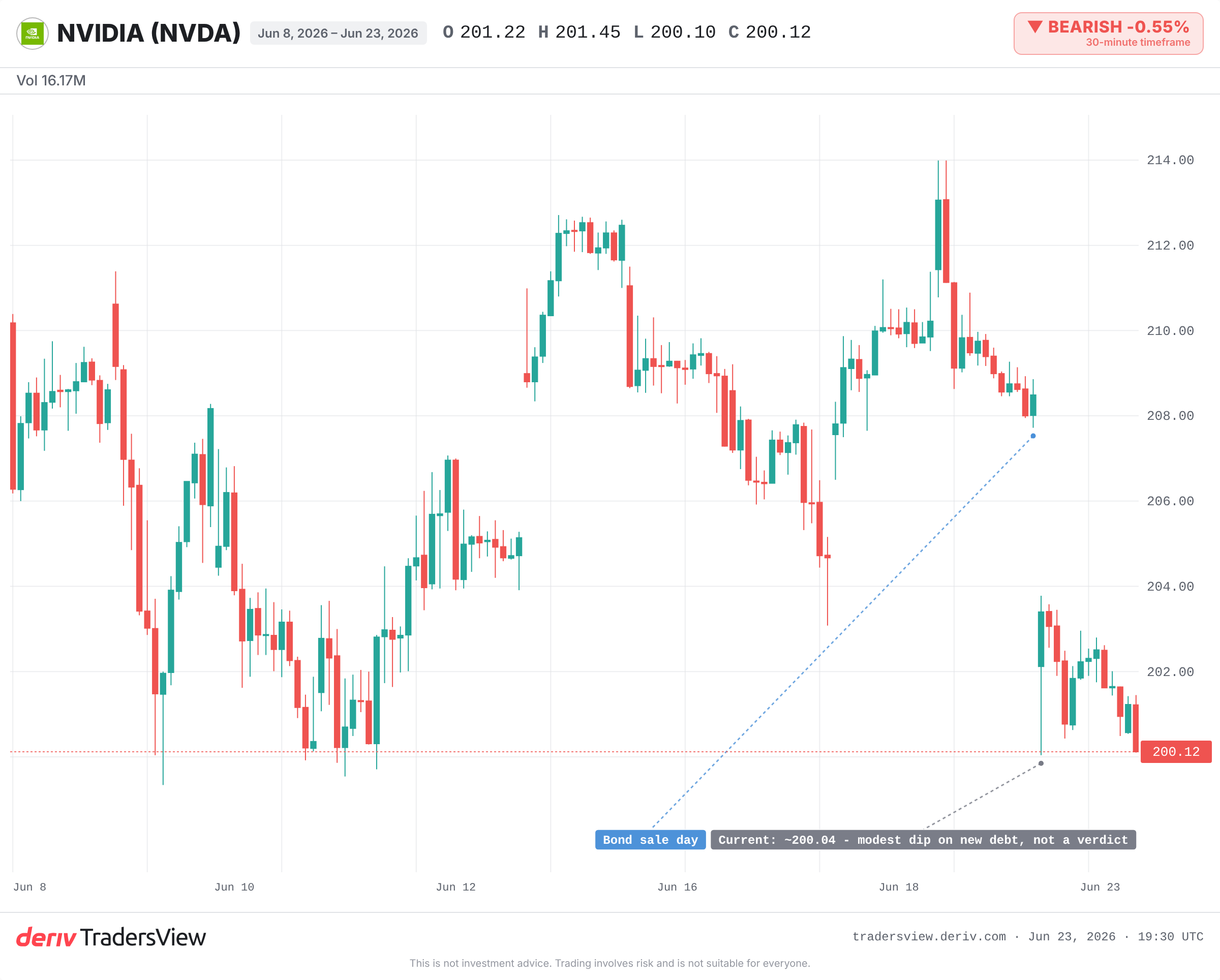
Why did Nvidia stock dip on the news?
Nvidia shares slipped around 1.5% on the day of the sale and have drifted a little lower since. That is normal. New debt adds a fixed obligation, and equity holders price that in.
It is not a verdict on the strategy. Dell tells the other half of the story: a record $51.3 billion AI server backlog and a stock that has climbed hard. Demand for the hardware is real, and the debt is funding the capacity to meet it.
When the tool becomes a trap
Debt only works if the revenue arrives. That is the honest risk here.
The four biggest US hyperscalers have guided to $700 billion to $725 billion of capex in 2026, up roughly 75% on the year. Much of it is debt-funded. If AI revenue lags that build, the cheap debt becomes a fixed bill against softer cash flows.
The late-1990s fibre boom is the cautionary mirror. Telecoms borrowed heavily to build ahead of demand. When the demand came late, several over-levered names collapsed in the 2000-2002 bust.
Goldman Sachs and other credit analysts are now watching one question: does capex outrun AI revenue? The evidence leans toward this being sound capital management while bond demand stays strong and spreads stay tight. The tell that would flip the read is investment-grade spreads widening and order books for future AI bond sales thinning out. Watch LQD for the first sign of fading appetite.
This is education, not advice. Debt-funded growth rewards conviction when revenue shows up and punishes it when it does not.
Frequently asked questions
It means investors placed more orders than there were bonds available. Nvidia's $25 billion sale drew over $85 billion in orders, so demand outstripped supply by more than three times. It signals strong lender confidence in the borrower.
Interest on debt is usually tax-deductible, which lowers the effective cost. Borrowing also keeps a company's cash free for other uses and lets it lock in a fixed rate, which can be cheaper than spending equity once tax is factored in.
Heavy issuance can stay healthy while demand is strong and spreads are tight, as they have been. If appetite fades, spreads widen and bond ETFs like LQD weaken, which would be an early sign the market is less comfortable funding the AI build.
Debt servicing costs are fixed, but AI revenue is not guaranteed. If hyperscaler capex outpaces actual revenue growth, the same cheap debt becomes a fixed obligation against softer cash flows. Analysts at Goldman Sachs are monitoring exactly this.