
Why Do Brand-New Stocks Swing So Hard? The Thin-Float Trap
When only a few percent of shares can trade, a thin float exaggerates rallies and drops. Here is how to read IPO price action before drawing conclusions.
By the Deriv desk · 22 June 2026 · 4 min read

When only a few percent of a company's shares can actually trade, the price everyone watches is set by that thin slice. That makes early moves bigger and faster than the business itself.
SPCX is the live case. Roughly 3 to 5 percent of its shares are tradable. The rest is locked up. So the loud price swings you see are formed in a tiny pool of supply, not a deep, liquid market.
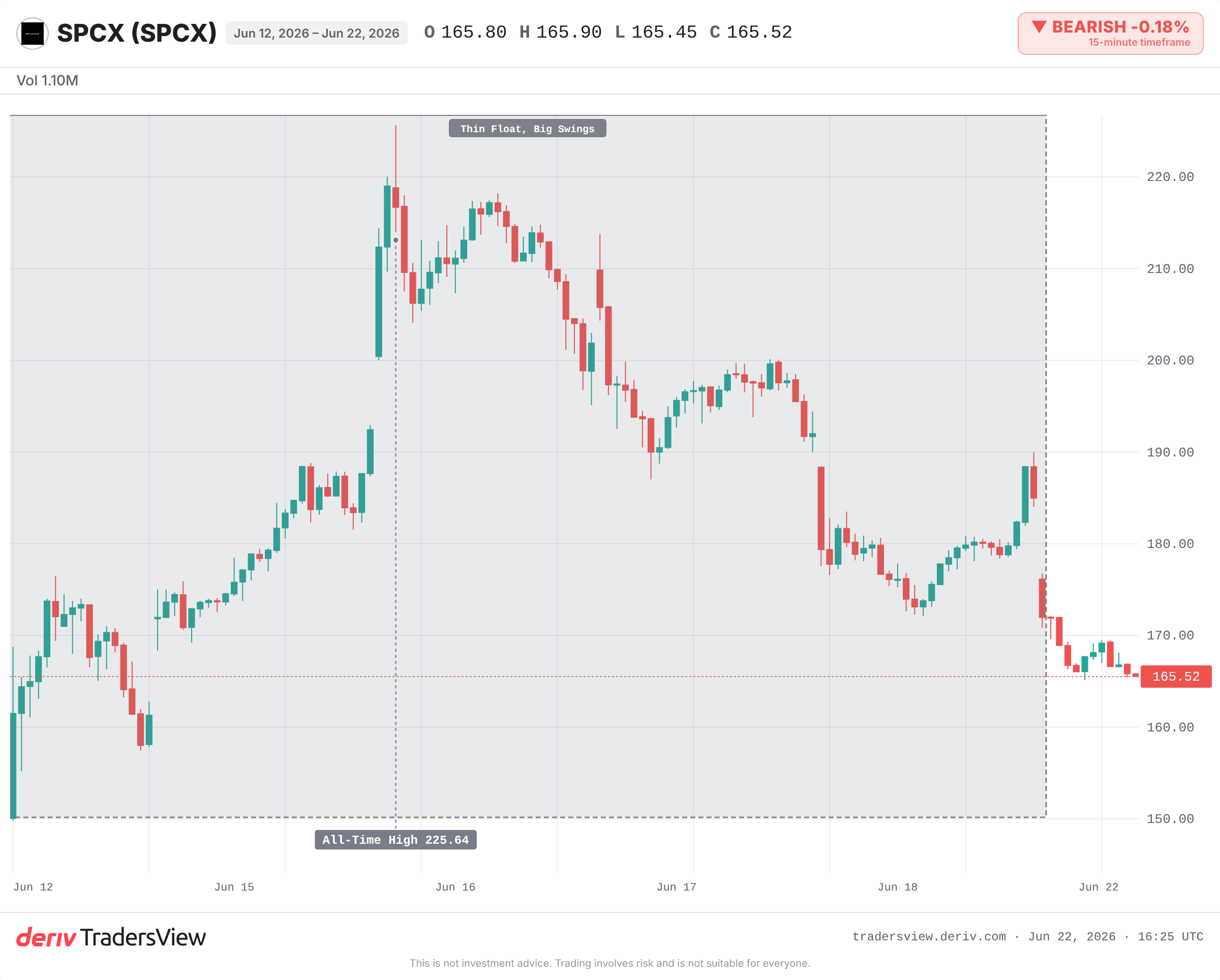
Why a thin float makes a stock move so fast
Picture a crowded room with one narrow door. A few people can pass calmly. A rush, and the door becomes the whole story.
A thin float works the same way. With few shares available, modest buying or selling moves the price a lot. The number millions watch reflects scarce supply more than company value.
In a thin float, the price tells you about supply first and the business second. A deep large-cap absorbs big orders with small moves. A fresh listing with a sliver of float does the opposite.
How far has SPCX actually fallen?
SPCX hit an all-time high on June 16, 2026, then slid. As of the live feed it trades around the mid-160s, roughly a quarter below that peak.
On June 22, KeyBanc analyst Michael Leshock started coverage at Sector Weight, a neutral call with no price target. A $20 billion bond sale added a separate pressure point. But the size of the drop owes as much to thin supply as to any single headline.
Does a big drop mean the business lost value?
Not on its own. The trap is reading a sharp move as a verdict on the company. In a thin float, the move can be mostly mechanics.
The analyst range here is the tell. Morningstar's fair value sits near the low 60s. Arete targets near 400. New Street and Oppenheimer land in between. A spread that wide means the market has not settled on a value, so day-to-day price is doing the arguing.
History rhymes. Beyond Meat spiked far above its IPO price on a small tradable float, then fell hard as lockups expired and supply grew. Rivian rocketed to a carmaker-sized valuation, then reset lower as locked shares unlocked. The early move was real, but it faded when more shares could trade.
The catch: thin float cuts both ways
Scarcity amplifies declines. It can amplify recoveries just as violently. The same thin door that jams on the way out can jam on the way back in.
There is also a feedback loop. SPCU, a 2x long SpaceX ETF launched on June 16, mechanically doubles each daily move and compounds losses on the way down. That can feed back into the swings.
The next structural event is a float expansion reported for early August, lifting the tradable slice from under 5 percent toward roughly 12 percent. More supply tests demand directly. If buyers absorb the larger float without a deep drop, that says real demand, not just scarcity, is setting the price.
What to watch before drawing conclusions
- The August float expansion: does the bigger supply get absorbed or pressure price?
- The analyst range: if it narrows, the market is converging on a fair value.
- Whether the stock holds or breaks the recent area it now trades around.
- Further lockup or financing news that adds tradable shares.
The honest read: short-term price action in a thin-float listing says more about supply than fundamentals. Treat the swings as noise about scarcity until the float deepens and the value range tightens. This is education, not a trade call, and early listings carry real risk in both directions.

Frequently asked questions
Float is the number of shares actually available to trade, after locked-up and restricted shares are removed. A small float means few shares change hands, so the price can move a lot on modest buying or selling.
A lockup expiry releases more shares into the tradable supply. If demand does not grow to match, the added supply can pressure the price lower, which is why early post-lockup periods are often volatile.
A 2x ETF aims to double the underlying's daily move. Over multiple volatile days that compounds, so losses can deepen faster than the underlying falls, and the daily reset means returns drift from a simple 2x over time.
Look at how much float is tradable and how wide the analyst value range is. A tiny float plus a huge target spread suggests the move is driven by scarce supply and positioning, not a settled view of fundamentals.